

Gregori's Songwriting Workbook: From Riff to Finished Song
You've Got the Ideas. This Is How You Finish the Songs.
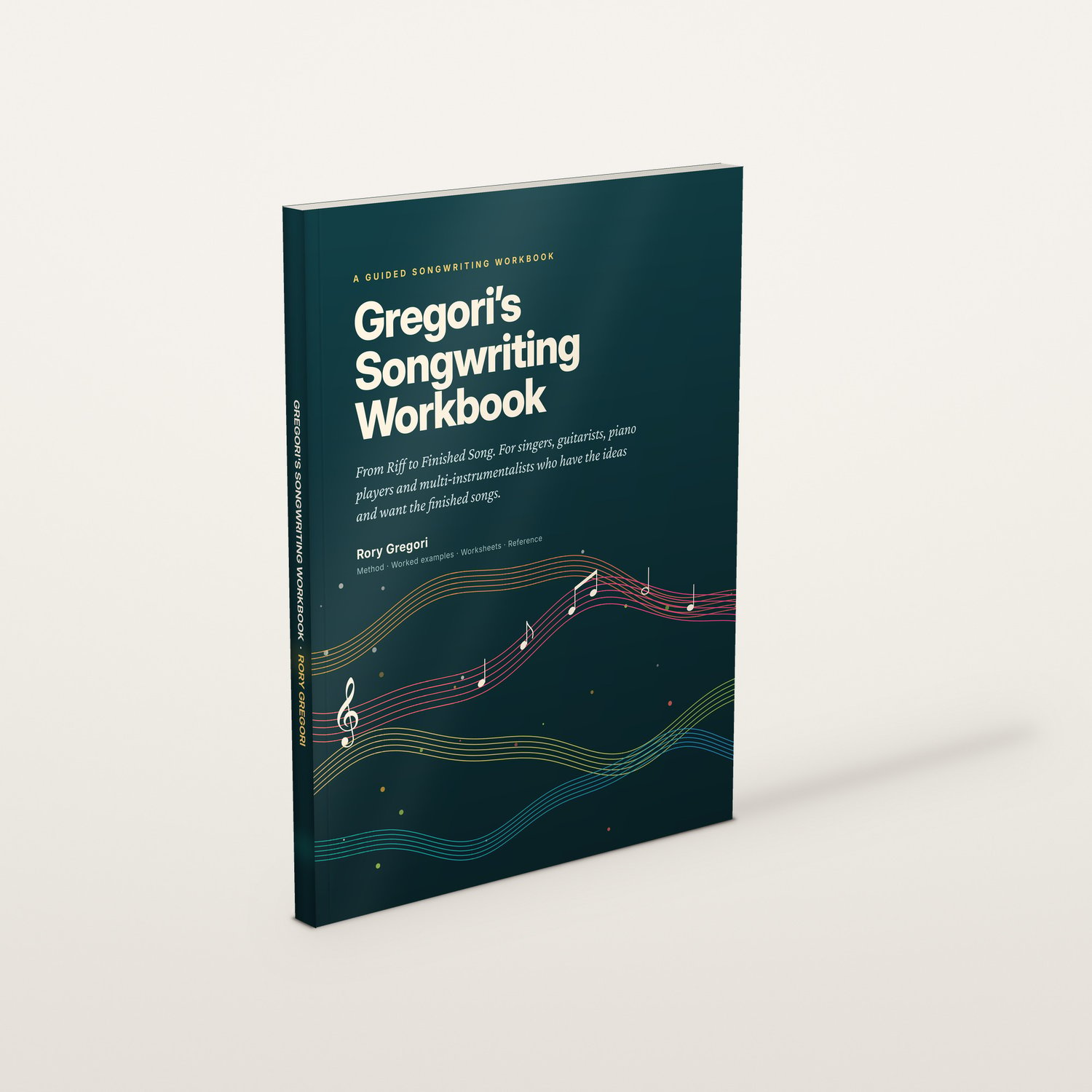
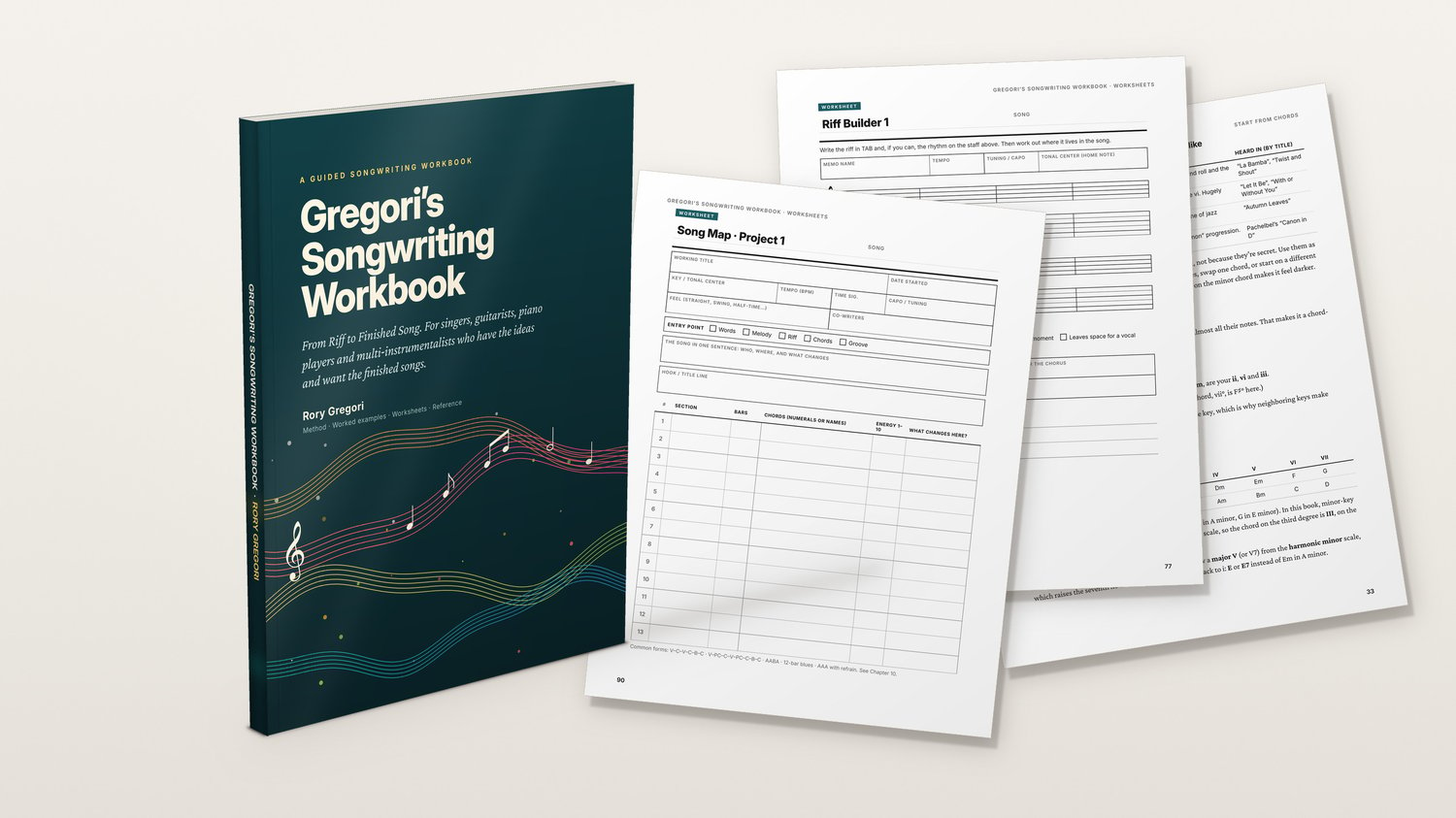
Gregori's Songwriting Workbook is a 163-page guided method that takes the riffs, hums and half-choruses on your phone and turns them into three finished songs in about six weeks, whether you start from words, melody, a riff, chords or a groove.
Instant PDF download · 163 printable pages · For singers, guitarists, piano players and multi-instrumentalists
🔒 Secure checkout · Pay by card (processed by Stripe) or PayPal · Your download arrives instantly by email
Maybe this sounds familiar
Your phone has a folder full of voice memos called New Recording 47. Somewhere in there is a riff you still love. You've got half a chorus in a notebook and a chord change that gives you goosebumps every time you play it.
Starting songs isn't your problem. You start them all the time.
The trouble starts at bar eight.
The riff is great. The first verse is great. Then the song stalls, because nobody ever showed you what comes next:
- How do you build a second section that contrasts with the first, so the chorus actually sounds like a chorus?
- How do you write a second verse that isn't just the first verse in different words?
- How do you find the notes of a melody you can hear clearly in your head?
- And how do you know when a song is done?
So the idea goes back in the folder. Then another one joins it. A year later you've got a hundred beginnings and nothing you'd play for a friend.
It isn't a talent problem, and you don't need more inspiration. You're missing a method, a way to get from the piece you have to the song you want.
Why I wrote this workbook
From Rory Gregori
I've played music for a long time, but I didn't get seriously curious about songwriting until I became a multi-instrumentalist.
When I was younger I listened to Pink Floyd constantly, and I remember thinking about how David Gilmour made his guitar speak, sing and soar. I could sing the guitar part I imagined. I just couldn't play it.
I had the melody, but I couldn't find the notes.
Later, trying to get past the intermediate stage on guitar, I hit a new wall: how do you perform a whole song without a backing band? Working that out showed me the structure hiding inside the songs I loved.
My guitar teacher, who opened for Eric Clapton at the height of his career in 1985, noticed that the guitar parts I wanted to learn all followed an interesting common theme. They were blues-influenced rock songs with strong guitar solos, and many of them centered on the D minor pentatonic scale.
Piano helped too. It's where chords, keys, the circle of fifths and harmony finally clicked for me.
That taught me something. The gap between hearing something in your head and finding it on an instrument is where most songs die. I didn't need more inspiration. I needed a way to catch an idea, find its notes, work out its key, and then build the rest of the song around it one piece at a time.
This workbook is that method, the one I wish I'd had, laid out in the order you'll need it. The goal is the same one I had when I made the first edition in 2023: write a song that moves you.
Here's what you'll finish
Work through the book at three or four sessions a week, and in about six weeks you'll have three complete songs. Each one comes with:
- A written Song Map: every section, bar count, chord, and energy level on one page
- A Lyric & Chord Sheet with chords lined up over the words
- An Energy & Instrument Plan showing who plays what, section by section
- A rough demo you've recorded, named and backed up
You can go faster or slower if life gets in the way. As the book says, a song finished in eight weeks still counts.
The six-week plan
- Week 1 · Chapters 1–6: Set up your Idea Log. Do five 10-minute Continuous Lyric Journeys. Capture at least ten ideas.
- Week 2 · Chapters 7–9: Write three riffs, three progressions and two grooves. Pick your three strongest ideas and open Song Projects 1–3.
- Week 3 · Chapter 10: Choose a form for Song 1 and fill in its Song Map. Draft every section, even badly.
- Week 4 · Chapters 11–12: Draft Song 2. Do a lyric and word-melody fit pass on Song 1.
- Week 5 · Chapter 13: Draft Song 3. Build energy maps for all three. Record a rough demo of Song 1.
- Week 6 · Chapters 14–16: Rewrite all three. Demo Songs 2 and 3. Play them for someone.
Yes, I Want to Finish Three Songs: $49 →
What's inside: 163 pages, six parts
Part I · Orientation (Chapters 1–3)
- Welcome: What You Will Finish. The promise, the six-week plan, and how to use the pages (pencil for drafts, pen for keepers).
- My Story. Why the book exists, plus a 5-minute Before You Start exercise: write down the one song you wish you'd written, and why. That's your north star.
- How Songs Work. What each section is for (intro, verse, pre-chorus, chorus, post-chorus, bridge, solo, outro) and how long each usually runs. It also covers the difference between a hook and a chorus, the four kinds of hook, and the energy curve. Exercise: Map a Song You Love (15 min).
Part II · Getting Ideas (Chapters 4–9): five ways into a song
- Capture Habits. Record first, write later. Name memos so you can find them again, and keep an Idea Log. Exercise: Start Your Log (10 min).
- Start from Words. Three tools:
- The Continuous Lyric Journey, a timed freewrite using all seven senses. It builds on object writing, a technique popularized by Pat Pattison.
- Titles and hooks, and the three questions every title raises.
- The Story Frame: place, time, character, something happens, new information, resolution.
- Exercises: Continuous Lyric Journey (10 min), Twenty Titles (10 min), Story Frame (15 min).
- Start from Melody. Catch the tune in your head, then find its notes with four anchors (home, first, highest, lowest), even if all you have is a tuner app. Describe its shape so you can build on it. Exercise: Melody Capture (15 min).
- Start from a Riff. Kinds of riff, what makes one work, how to write it down with rhythm, and how to find the key of a riff correctly. (A scale box doesn't tell you the key.) Then how to grow a riff into a full section. Exercise: Riff Session (20 min).
- Start from Chords. The seven chords of a key, and home, away and tension. Four progressions worth knowing, using the circle of fifths to choose chords, minor-key progressions, and borrowing chords for color. Exercise: Chord Palette (20 min).
- Start from a Groove. Tempo ranges, straight, swing, half-time and double-time feels, and time signatures beyond 4/4. Read and write a groove grid, then start a song from a beat. Exercise: Groove First (15 min).
Part III · Building the Song (Chapters 10–13)
- Song Forms. Verse–chorus, verse–pre-chorus–chorus, AABA, 12-bar blues and strophic, with bar counts and a guide to choosing one. Exercise: Choose a Form (10 min).
- Lyrics That Land. Specific beats abstract. Five rhyme types, four rhyme schemes, Word-Melody Fit (making your words' natural stress match the music), point of view and tense, and the fix for the second-verse problem. Finish with a cliché scan. Exercise: Rhyme and Word-Melody Fit Pass (20 min).
- Melody, Lyric and Contrast. Why a chorus sounds like a chorus, with a contrast checklist covering eight elements. Plus how to match verse 2 to verse 1 and where the title should go. Exercise: Contrast Audit (15 min).
- Arrangement and the Energy Map. The book's signature tool. Rate every section 1–10, then use seven energy levers and four rules of thumb to decide what plays where. Includes how to arrange as a solo performer. Exercise: Map Your Energy (20 min).
Part IV · Finishing (Chapters 14–16)
- The Rewrite Pass. Put the song away, listen back as a stranger, then fix one category at a time. Five tests tell you whether a song is finished. Exercise: Stranger Test.
- Demo It. A 15-minute phone demo and an afternoon DAW demo, built step by step, plus naming, versions and 3-2-1 backups. Demo checklist included.
- Co-Writing and Protecting Your Song. How to run a good co-write, agree splits and sign a split sheet. Copyright, PROs and royalties explained in plain language. (General information, not legal advice.) Business checklist included.
Part V · Worksheets (about 90 pages of working pages)
- Song Index · Idea Log · Continuous Lyric Journey · Story Frame · Title & Hook Bank · Rhyme Workshop · Melody Capture
- Riff Builder 1–7 · Chord Palette · Groove Grid
- Ten complete Song Projects, four pages each: Song Map, Energy & Instrument Plan, and two Lyric & Chord Sheets
- Lined writing pages · Guitar staff + TAB · Bass staff + TAB · Keys grand staff
- Demo & Audio Log · Rewrite Pass checklist · Co-Write Split Sheet
Part VI · Reference (Appendices A–H)
- Notation guide · Chords in every major key · The four core progressions in all 12 keys · Minor keys · An original circle of fifths · Keyboard and fretboard maps · Open-chord chart · Glossary
One song, all the way through
Every chapter follows one example song, "Three Novembers", written for this book. It starts as a two-bar guitar riff in E minor. Along the way you watch it pick up a story, a chorus, a chord plan, a melody, an energy map, three real rewrites and a demo. One rewrite turned a cliché into the title. Another moved the melody's leap onto the right syllable, and another cut the song from 4:40 to 3:35. Whenever you're stuck, look at what happened to "Three Novembers" at the same stage.
Get the Workbook and Start This Week →
Is this for you?
This workbook is for you if:
- You have more musical ideas than finished songs
- You're a singer, guitarist, piano player or multi-instrumentalist, and you write the lyrics, the music, or both
- You're a hobbyist or aspiring songwriter who wants a clear, step-by-step path instead of more random tips
- You'd rather do than read. Every chapter ends with a timed exercise, most of them 10 to 20 minutes
- You don't read music, or only a little. You don't need to.
- You sing but don't play. You'll capture ideas with your voice and get chords from a collaborator, a chord app or a backing track, and the book flags the few steps to adapt.
What you need: your phone's voice memo app, a pencil, a willingness to sing (badly is fine), and the ability to count to four. If you play, a handful of open and barre chords on guitar, or basic chords on keys, is plenty.
It's probably not for you if:
- You want a music-theory textbook. The theory here is practical and only goes as far as you need to write.
- You're looking for music production or mixing lessons. The demo chapter is about capturing the song clearly, not about making a polished record.
- You want a music business or career course. Chapter 16 covers the basics of splits, copyright and royalties, not how to get a publishing deal.
- You want to read it and not write. The book only works if you fill in the pages.
- You need a printed book today. This is a digital PDF that you print yourself.
Price and value
The whole workbook is $49, a one-time purchase for the full 163-page PDF.
Here's what that $49 gets you:
- A complete method, 16 chapters from first idea to finished demo, plus 15 timed exercises
- Ten Song Projects, each with a map, an energy plan and lyric sheets, so you're set up for well past your first three songs
- A reference section you'll keep coming back to: chords in every key, progressions in all 12 keys, the circle of fifths and fretboard maps
- Printable, reusable pages. You can photocopy the worksheets for your own songwriting, so you never run out of Song Maps or Riff Builders.
Put another way, it's less than many single music lessons and less than most guitar pedals. Instead of a single lesson, you get a plan you can work through again and again, every time a new idea shows up.
Get Gregori's Songwriting Workbook: $49 →
Try my teaching first, free
This is an instant digital download, so all sales are final. But you don't have to buy it to find out whether my teaching works for you.
The free Riff to Chorus Starter Kit is ten real pages from this workbook: the six-week plan, the Song Map with a finished example, the Idea Log, From Riff to Section, the Riff Builder and the Four Progressions cheat sheet. Print it, pick one idea, and map it out. If that session gets your song moving, the full workbook will take you the rest of the way.
And if you ever have trouble with your download, email rory.gregori@songbuildersworkshop.com and I'll sort it out.
Questions
Do I need to read music?
No. Chords are written as letter names, and the book explains the Roman-numeral system in plain English. The staff paper has room for TAB and for writing the count (1 & 2 & 3 & 4 &) over your notes. The notation guide in the back covers the rest.
I sing, but I don't play an instrument. Will this work for me?
Yes, for almost all of it. You'll capture ideas with your voice and get chords from a collaborator, a chord app or a backing track. The book points out the few steps to adapt, like humming riffs into a voice memo for a player to work out.
I only play guitar. Or only piano.
Either is fine. A handful of open and barre chords on guitar, or basic chords on keys, is plenty. There's staff paper for guitar, bass and keys, plus keyboard and fretboard maps.
What genres does it cover?
The method works for any style built on sections, chords and melody. The examples range from rock, pop and country to blues, folk and jazz standards, and the book covers verse–chorus, AABA, 12-bar blues and strophic forms.
How much time does it take?
The plan assumes three or four sessions a week for about six weeks. Most exercises take 10 to 20 minutes. Go at your own pace. A song finished in eight weeks still counts.
Is it a printed book?
It's a 163-page PDF in US Letter size that downloads instantly. Print the whole thing, print only the worksheets you need, or fill it in on a tablet.
Can I print the worksheets more than once?
Yes. You may photocopy the worksheets for your own songwriting. The book holds ten Song Projects, and when you run out you can print more.
I've already downloaded the free Starter Kit. What's different?
The Starter Kit is ten pages: the six-week plan, the Song Map, the Idea Log, the Riff Builder and a progression cheat sheet. The full workbook is everything else across 163 pages: all 16 chapters, 15 timed exercises, ten Song Projects, all seven Riff Builders, every worksheet, the full reference section, and "Three Novembers" followed all the way through.
Does it cover copyright and getting paid?
Chapter 16 covers co-writing, split sheets, copyright, PROs and royalties in plain language. It's general information, not legal advice, and it points you to the official sources.
What if I have a problem with my download?
Email rory.gregori@songbuildersworkshop.com and I'll help.
What's your refund policy?
Because the workbook is an instant digital download, all sales are final. That's why the Riff to Chorus Starter Kit is free: it's ten real pages from the workbook, so you can try my method on one of your own ideas before you spend a cent. If it clicks, the full workbook is ready when you are. Get the kit at https://shop.songbuildersworkshop.com/b/vKDUH
Your songs are waiting
Somewhere on your phone there's a riff, a hum or a line of lyric that deserves to be a finished song.
You don't need more inspiration to get it there. You need the next step, then the one after that. This workbook lays them all out, in order, from the first voice memo to a demo you're proud to play for someone.
Get Gregori's Songwriting Workbook: $49 →
Write a song that moves you.
Rory Gregori
P.S. Not ready yet? Start with the free Riff to Chorus Starter Kit: ten real pages from the workbook, including the six-week plan, the Song Map and the Riff Builder. Get it at https://shop.songbuildersworkshop.com/b/vKDUH